Mosquero del Pac铆fico
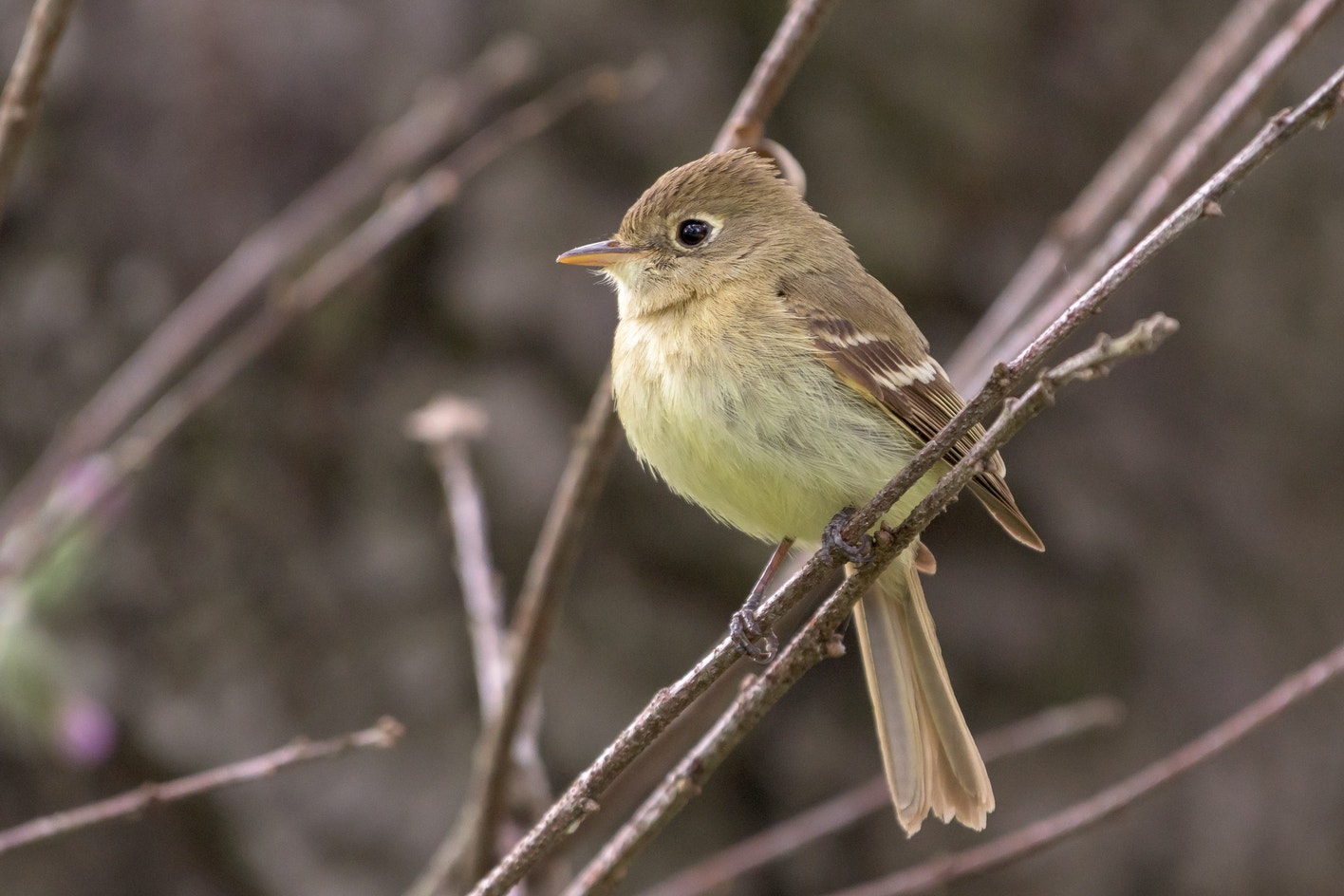






Mosquero del Pac铆fico
Empidonax difficilis
A simple vista
The well-named Western Flycatcher is indeed very widespread in the West. Its summer range extends from the Pacific Coast to the Rocky Mountains, and from southeastern Alaska to southern Mexico. It favors deep shade of humid woods, often in the groves along streams, and it often places its beautiful mossy nest under a bridge or under the eaves of a cabin in the woods. For several years, the Western Flycatcher was divided into two species: Cordilleran Flycatcher, nesting in mountains in the interior, and Pacific-slope Flycatcher, all along the Pacific seaboard. However, these two were almost identical, with only slight differences in voice and genetics, and in 2023 they were combined into one species again.
Todo el texto de la gu铆a de aves y los mapas de distribuci贸n fueron adaptados de de Kenn Kaufman漏 1996, utilizado con permiso de Houghton Mifflin Harcourt Publishing Company. Reservados todos los derechos.
颁补迟别驳辞谤铆补
Perching Birds, Tyrant Flycatchers
IUCN Status
Least Concern
贬谩产颈迟补迟
Arroyos y ca帽ones, Bosques y bosques, Monta帽as altas, Arbustas, sabanas y matorrales
搁别驳颈贸苍
Alaska y el norte, California, Noroeste, Grandes Llanuras, Monta帽as Rocosas, Suroeste, Texas, Oeste de Canad谩
Comportamiento
Rareza, Flotador
笔辞产濒补肠颈贸苍
13.000.000
Rango e identificaci贸n
Mapa de migraci贸n y distribuci贸n
During migration, it commonly occurs in the lowlands of much of the West, as birds travel to and from Mexico. Those breeding along the Pacific Coast winter mainly in the lowlands of western and southern Mexico, while those breeding in the Rockies and elsewhere in the interior winter mostly in Mexico鈥檚 foothills and mountains.
顿别蝉肠谤颈辫肠颈贸苍
Both sexes 鈥� Length: 5.5鈥�6.7 in (14鈥�17 cm); wingspan: 7.9鈥�9.1 in (20鈥�23 cm); weight: 0.3鈥�0.5 oz (8鈥�13 g). The Western Flycatcher is tinged greenish above, with a distinct yellow wash on the throat. Eye-ring extends behind the eye in a teardrop shape. From below, the bill looks wide, with an orange lower mandible.
罢补尘补帽辞
About the size of a Sparrow
Color
Marr贸n, Verde, Blanco, Amarillo
Forma de alas
Rounded
Forma de cola
Notched, Square-tipped
Cantos y llamadas
A rising whee-seet or pseet-ptsick-seet. Call note a sharp pit-peet or a very high-pitched, sibilant pseeet.
Patr贸n de canto
Flat, Rising
Tipo de canto
Chirp/Chip, High, Whistle
贬谩产颈迟补迟
Moist woods, mixed forests, shady canyons. The Western Flycatcher breeds in wet forested regions near the coast or in mountains. Often common in zones of coniferous forest, but there it seems to concentrate in deciduous growth, such as maples and alders, along streams. Also found in canyon groves of oak, sycamore, or willow.
Suscr铆base al bolet铆n de 51猎奇入口 para obtener m谩s informaci贸n sobre aves como el Mosquero del Pac铆fico
Comportamiento
Huevos
3-4, rarely 5. Whitish, with brown blotches concentrated near the larger end. Incubation is by female only, about 14-15 days.
颁谤铆补
Both parents bring food for nestlings. The age of young at first flight is about 14-18 days.
Comportamiento alimentario
Forages by watching from a perch, at any level within shady parts of the forest, and then flying out to catch insects in the air. Also takes some food (such as caterpillars and spiders) from foliage or twigs while hovering.
Dieta
Mostly insects. The Western Flycatcher feeds on a variety of insects, including small wasps, bees, flies, true bugs, caterpillars, moths, beetles, and others. Also eaten are spiders, a few berries, and seeds.
狈颈诲颈蹿颈肠补肠颈贸苍
In the Pacific Northwest, the Western Flycatcher and Hammond's Flycatcher may defend territories against each other. Nest site is sometimes in the fork of a small tree, but usually in other situations: in a cleft of a vertical streambank, on a stump, among the upturned roots of a fallen tree, under a small bridge, or on rafters in a shed. Natural sites are usually near (or on) the ground, but on artificial structures, the nest may be more than 10' up. Nest (built by female) is a cup of moss, grass, rootlets, strips of bark, lichens, and leaves, lined with finer material such as plant fibers, hair, feathers.
Vulnerabilidad
Estado de conservaci贸n
The Western Flycatcher may be affected by the cutting of forests in the West; however, it remains widespread and common.
Amenazas clim谩ticas que enfrenta el Mosquero del Pac铆fico
Elija un escenario de temperatura a continuaci贸n para ver qu茅 amenazas afectar谩n a esta especie de ave a medida que aumente el calentamiento global. Las mismas amenazas impulsadas por el cambio clim谩tico que ponen en riesgo a las aves afectar谩n tambi茅n a otras especies de vida silvestre y a las personas.
