

A Bright (Blue) Note in IUCN Update
The Lear's Macaw population is on the rise, thanks to conservation efforts.
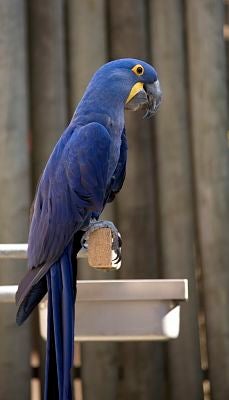 Photograph by Shankarr, on Flickr Creative Commons |
These days, it seems like most environmental news鈥攑articularly about animal and bird species鈥攊s of the hide-under-your-covers, plug-your-ears sort.
Scientists warn of a sixth great extinction much like the one that ended the dinosaur reign.
But I鈥檓 here to suggest you come out from under the covers鈥攁t least for the moment. I have good news: The population of the Lear鈥檚 macaw, a rare blue parrot found in northeastern Brazil, is on the rise, triggering the (IUCN) to on its .
It鈥檚 one of six bird species the IUCN downlisted in its May 2009 update. The others are the chestnut-bellied hummingbird, the minas gerais tyrannulet, Kaempfer鈥檚 tody-tyrant, the mauritius fody, and the Chatham petrel.
The number of Lear鈥檚 macaws has increased exponentially from its low point of fewer than 100 birds in the late 1980s. Information from the (ABC) and , IUCN鈥檚 official bird source, puts today鈥檚 population somewhere between 400 and 950 birds.
The resurgence of these macaws is due, in part, to by ABC and Brazilian partner Funda莽茫o Biodiversitas that include a land purchase of approximately 4,000 acres of the birds鈥� habitat and reforestation of its primary food source, the licuri palm.
Of course, there鈥檚 still work to be done: The species is one of more than 1,200 threatened birds on IUCN鈥檚 list, as and blogged about in previous Perch posts. And the macaw is still vulnerable to the illegal wild bird trade and loss of habitat that previously threatened this species.
But it鈥檚 worth taking a moment to smile at the thought that if this positive trend continues, more of these beauties will be flying around northeastern Brazil鈥攁nd that conservation efforts can work.
