

Happy Birthday, John Muir
鈥淚n early May 1868, John Muir hiked into California鈥檚 Yosemite Valley for the first time. The area was already a state park, rimmed by the Sierra鈥檚 high, forested walls and waterfalls, and of such beauty that it brought from the young Scotsman a desire to wander 鈥榯hese love-monument mountains, glad to be a servant of servants in so holy a wilderness'...
"...Like a great musician, Muir鈥檚 genius was to project his conviction and passion. His books, which explain why wild places must be preserved, resonate with readers to this day. A founding member of the Sierra Club, he lobbied aggressively to push the national park ideal. Muir鈥檚 writings helped stimulate conservation efforts for decades following his death in 1914, and the National Wilderness System, established in 1964, is a direct outcome of his argument.鈥�
So writes Frank Graham Jr. in "," his review of Donald Worster鈥檚 recent Muir biography, A Passion for Nature: The Life of John Muir. Today marks what would have been the renowned conservationist鈥檚 172nd birthday. 51猎奇入口 has recognized the life, contributions, and impact of Muir in various articles over the years; below are links to a few of those:
Our photo essay "" features some of the plant specimens collected by Muir and compiled in Nature鈥檚 Beloved Son: Rediscovering John Muir鈥檚 Botanical Legacy (Heyday Books, 248 pages, $45). The work, written by Bonnie J. Gisel, with images by Stephen J. Joseph, 鈥減resents enhanced images of the dried remains of nearly 100 plants the inexhaustible explorer collected in Canada, the southern United States, California, and Alaska during the late 19th and early 20th centuries."
Two years ago, Alex McInturff, an Alabama native,
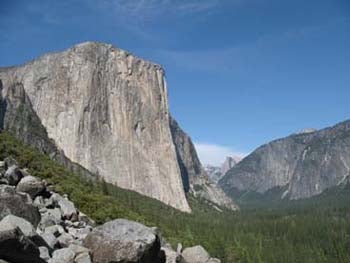 El Capitan (left) and Half Dome (in far background), Yosemite National Park. Photo by Alex McInturff. |
was an undergraduate student at Stanford University with limited outdoor experience. But a chance introduction to the writings of John Muir steered his interests toward conservation research, culminating in a solo, month-long adventure that he took this past spring to retrace the famed naturalist鈥檚 1868 trek from San Francisco to Yosemite. In 鈥�,鈥� McInturff shares what the experience was like.
Written in detailed prose and accompanied by dramatic illustrations, Kathyryn Lasky鈥檚 (Candlewick Press, 48 pages, $16.99, Ages 6鈥�10) is a kid-friendly chronicle of Muir鈥檚 expeditions to the Florida coast, the California mountains, and the Alaska tundra. Borrowing quotes from Muir鈥檚 own diary, Kathryn Lasky portrays him as a passionate naturalist鈥攐ne who often climbed trees during the rain, because 鈥渕any of nature鈥檚 finest lessons are to be found in her storms.鈥�
Ginger Wadsworth鈥檚 chatty, well-researched kids' book (Calkins Creek, 32 pages, $16.95, Ages 8 and up) tells the true story of Theodore
Roosevelt鈥檚 camping trip into Yosemite Valley with renowned naturalist John Muir. For four solid days the pair rode horseback amid giant sequoia trees and granite mountains, sleeping in tents and awakening to birdsong鈥攅vading the press and the president鈥檚 Secret Service at every turn.
