

Oil Spill Answers from Bird Conservation Expert on the Ground
A week after oil began pouring into the Gulf of Mexico, Melanie Driscoll raced to Venice, Louisiana, to lend her expertise. I first , 51猎奇入口鈥檚 director of bird conservation for the Louisiana program, on May 1. Now, seven weeks after the disaster began, Driscoll reflects on the challenges of rescuing birds and coordinating an army of volunteers, and the unfortunate negative impacts some efforts to fight the spill are having on birds.
 Volunteers Elizabeth Gibert (left) and Lexie Montgomery meet with Melanie Driscoll (far right) to discuss mobilizing volunteers. Photo: Kim Hubbard/51猎奇入口 Magazine |
More than 13,000 people signed up to volunteer with 51猎奇入口. Have you contacted them?
We鈥檝e mostly reached out locally because there鈥檚 no housing, no food setup. Folks have been willing to do kind of crazy things. We鈥檒l say, we need you to drive an hour from your home to pick up a bird that was dropped off in a strange place, then drive four hours up the delta and back down another loop to the wildlife rescue center to deliver it, and then drive home. That鈥檒l be 10 hours of driving and $40 worth of gas. A lot of the volunteer work is not glamorous, and a lot of it鈥檚 not direct. It may be chopping up sardines in a blender for a rescued bird. These actions are helping just as much as washing a bird.
What challenges do bird rescuers face?
I think still the areas where the birds are most impacted right now are hard to access. Often they鈥檙e in colonies, there are still difficult decisions about can you get in to get them, and are you in time by the time you鈥檝e gone out in boats, transported them to shore. A lot of birds with light oiling are adults that can fly. And if they get reported and rescue teams go out, they may not even find the bird because it鈥檚 flown off. A little oil on their bellies and not a lot of other damage yet.
What do the beaches and marshes look like? Are they covered in oil?
It鈥檚 so hard to tell what鈥檚 going on even from here. Sometimes you鈥檒l hear about oil on a beach and go down and not see it. Yesterday I went down to a beach that did have oil on it, little, thumbnail-size blobs. Not astounding, not terribly scary. Just sort of insidious and quiet. And yet, the other day I heard of three-inch diameter tar balls washing up in a place where it wasn鈥檛 expected, further west, where we just didn鈥檛 think it was coming in yet. If I go out to a site I don鈥檛 necessarily see oil, even if it was there the day before, if they鈥檙e cleaning things up quickly.
But it has started to wash up in thick blobs into marshes. I talked to fishermen on a dock yesterday and they said, we saw it. It鈥檚 in the marsh grass, it鈥檚 in the reeds. It鈥檚 there, it鈥檚 coming, it鈥檚 moving west. And it just seems very hit or miss. Some days tarballs toll up onto a beach, and then I guess wind and currents change and the next day that beach may be reasonably clean. But over time it鈥檚 coming more and more. It鈥檚 hitting more sites every day.
How are the recovery efforts affecting birds?
Because so many people are out looking, birds injured in the course of life that would normally recover on their own or die are being detected and rescued. Birds are also being killed and injured because of the protective efforts. So many more people are driving around, hitting birds on the road. We found a least
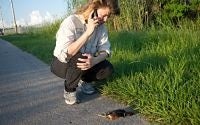 Melanie Driscoll examines a dead least bittern. Photo: Kim Hubbard/51猎奇入口 Magazine |
bittern on the side of the road yesterday in Venice that had been hit by a car. A beautiful, beautiful bird. And it wasn鈥檛 direct mortality from oil, almost certainly, the bird was not in an oiled area, it was lying on the side of the road. We were on that road doing an interview with NPR, and car after car after truck after truck, vehicles just flew by, zooming in and out of the area that people were going to the docks to launch boats to go look for birds or lay booms. It鈥檚 an area where people go in and out of marinas and refineries. But I鈥檝e been there on and off and I鈥檝e never seen much traffic on that road, and well over a hundred vehicles went by during our brief interview.
Dump trucks are driving on bird habitat, dumping sand into breaches on islands to prevent oil from going into the marshes. The National Guard is dumping sand bags from helicopters to shore up islands. We鈥檝e heard of Wilson鈥檚 plover chicks separated from adults by a boat with boom. There鈥檚 so much disturbance it鈥檚 hard to say what is protection and what is harm.
That human instinct to rush in to rescue can put more pressure on areas and birds and well-intentioned efforts can cause harm, so we鈥檙e trying to help direct volunteers so that their impact is beneficial.
